

The 3 Types of Dark Spots Women Over 40 See Most — And What Actually Works on Each One
The 3 Types of Dark Spots Women Over 40 See Most — And What Actually Works on Each One
By Cathi Carrier, Licensed Esthetician | 32 Years of Practice
You're not imagining it.
The dark spots showing up on your face, neck, and hands in your 40s feel different from the occasional sunspot you might have dealt with before, because they are different. They're deeper, more stubborn, and they multiply faster than anything you've tried to treat.
I've been a licensed esthetician for over 32 years. I've sat with thousands of women navigating this exact frustration. And the first thing I tell every single one of them is this: not all dark spots are the same. And if you're treating the wrong type with the wrong ingredients, you're spinning your wheels.
Here's what I want you to know — the science behind what's happening, the three types you're most likely seeing, and what actually works on each one.
Why Perimenopause Makes Dark Spots Worse
Before we get into the types, let's talk about why your 40s are such a turning point for hyperpigmentation specifically.
Estrogen plays a regulatory role in melanin production; it essentially helps keep your skin's pigmentation response in check. When estrogen begins its erratic fluctuation in perimenopause (and it fluctuates before it declines — that's the part nobody talks about), that regulation becomes unreliable.
The result: your melanocytes, the cells responsible for producing pigment, become hyperactive. They overreact to triggers they used to handle quietly, sun exposure, inflammation, heat, even friction. Pigment gets deposited unevenly, at deeper layers, in ways that take significantly longer to fade.
At the same time, cell turnover slows down. In your 20s, your skin cycled through new cells roughly every 28 days. By your mid-40s, that cycle can extend to 45–60 days. Dead, pigmented skin cells sit at the surface longer, making spots appear darker and more defined.
This is not sun damage catching up with you. This is a hormonal shift that changes how your skin creates and clears pigment, and it requires a targeted response.
The 3 Types of Dark Spots Women Over 40 See Most
Type 1: Solar Lentigines (Sunspots)
What they look like: Flat, well-defined spots ranging from light tan to dark brown. They appear on areas with the most sun exposure, the face, hands, chest, and shoulders. They tend to have clear, sharp borders and a relatively uniform color within the spot itself.
What causes them: Cumulative UV exposure over decades triggers melanin overproduction in localized clusters. After years of sun exposure, the melanocytes in certain areas become permanently more active. In perimenopause, declining estrogen removes a layer of protection that was quietly moderating this response.
Who gets them: Almost everyone who spends time outdoors without consistent SPF. The spots you wrote off as "just freckles" in your 30s often deepen and multiply in your 40s.
What actually works:
- Antioxidant protection is your first line of defense, and this is where astaxanthin, the hero ingredient in most of PURELY BELLA formulas, earns its place as a powerful marine antioxidant. Thoughtful prevention is always more effective than correction after the fact.
- Daily SPF (non-negotiable). Every unprotected moment continues to deepen existing spots and create new ones. If you do nothing else, do this.
- Gentle brightening ingredients — niacinamide, kojic acid, and antioxidant-rich formulas help gradually fade existing pigmentation without irritating perimenopausal skin.
- Patience. Solar lentigines are in the mid-to-deep epidermis. They fade with consistent treatment over 8–12 weeks minimum.
What doesn't work: Aggressive exfoliation or high-percentage chemical peels on inflamed, sensitized perimenopausal skin. These can trigger post-inflammatory hyperpigmentation, essentially creating the next problem while you're trying to solve this one.
Type 2: Melasma
What they look like: Larger, irregular patches of discoloration, often brownish or grayish brown, typically appearing symmetrically on the face. Common locations include the forehead, cheeks, upper lip, and bridge of the nose. Unlike sunspots, melasma patches tend to have soft, feathered edges and irregular shapes. They often look like a "mask" across the face.
What causes them: Melasma is driven by a combination of hormonal changes and UV exposure, which is exactly why it surges during perimenopause. Fluctuating estrogen and progesterone levels directly stimulate melanocyte activity. Sun exposure acts as the trigger that activates the pigmentation. Heat, including hot flashes, can also worsen melasma, which is why many women see flares they can't connect to sun exposure at all.
Who gets them: Women with medium to deeper skin tones are more prone, but melasma affects all skin tones. If you've been on hormonal birth control, experienced pregnancy mask (chloasma) in the past, or have a family history of melasma, your risk during perimenopause is higher.
What actually works:
- Antioxidants that target inflammation, not just pigment. Melasma lives deeper than sunspots, it's partly in the dermis, and it's driven by ongoing inflammation at the cellular level. This is where astaxanthin's anti-inflammatory properties are particularly valuable. By calming the inflammatory signals that trigger excess melanin production, you address the cause, not just the symptom.
- Strict, consistent sun protection. Even brief UV exposure can reverse weeks of fading progress with melasma. SPF 30+ every morning, every day, rain or shine.
- Avoiding heat triggers. Hot yoga, extended time in saunas, and unprotected heat exposure can flare melasma without any sun exposure at all. Our Serenity Cooling Mist was formulated to help manage exactly this — calming skin during hot flash episodes and resetting temperature-stressed skin throughout the day.
- Consistent, gentle brightening. The key word is gentle. Melasma is notoriously reactive to aggressive treatment. Stripping, over-exfoliating, or using high-percentage actives on melasma-prone skin often worsens pigmentation rather than reducing it.
What doesn't work: Treating melasma like a sunspot. It runs deeper, has a hormonal driver that is still active, and will return if that driver isn't addressed alongside topical treatment. Many women see initial improvement then plateau, that's usually because they're only treating the visible pigment, not the hormonal inflammation underneath.
Type 3: Post-Inflammatory Hyperpigmentation (PIH)
What they look like: Flat marks left behind after an acne breakout, irritation, rash, or any skin injury. They range from pink to red to brown to dark brown, depending on your skin tone. They appear exactly where the inflammation or breakout occurred, and in perimenopausal skin, they can linger for months.
What causes them: When skin experiences inflammation, from a breakout, a reaction to a product, friction, or any trauma, melanocytes respond by producing excess pigment at the site of injury. This is your skin's protective response. The problem in perimenopause is twofold: hormonal fluctuations are causing more breakouts and skin reactivity, and slowed cell turnover means the marks left behind take significantly longer to clear.
Who gets them: Women experiencing hormonal acne in their 40s are especially vulnerable, because every breakout has the potential to leave a lasting mark. Darker skin tones are more prone to PIH, and the severity tends to increase with perimenopausal inflammation.
What actually works:
- Treating the source of inflammation first. You cannot fade PIH if new inflammation keeps creating it. If hormonal breakouts are the trigger, address those with a gentle, non-comedogenic routine before layering in brightening actives.
- Antioxidants to reduce inflammation at the cellular level. PIH is fundamentally an inflammatory response. Astaxanthin's ability to neutralize oxidative stress and calm skin inflammation makes it one of the most effective ingredients for reducing the intensity of PIH marks while preventing new ones from forming.
- Niacinamide is well-tolerated by sensitive, perimenopausal skin and helps interfere with the transfer of pigment to skin cells, gradually lightening PIH without causing further irritation.
- Barrier support. Sensitized, compromised skin creates more PIH than healthy skin. Keeping your barrier strong is one of the most effective long-term strategies for reducing how dark and lasting your PIH marks become.
What doesn't work: Picking. I know I don't need to say it, but I'm saying it anyway. Picking at breakouts on perimenopausal skin creates deeper inflammation, a larger wound, and significantly darker, longer-lasting PIH.
The Common Thread: Inflammation and Antioxidant Defense
Here's what I want you to take away from all three types: inflammation and oxidative stress are at the root of every one of them.
Sunspots are created by UV-triggered oxidative damage. Melasma is driven by hormonal inflammation and UV. PIH is a direct inflammatory response.
This is why, after 32 years of practice, I formulated most PURELY BELLA products around astaxanthin — not Vitamin C, not retinol, not the trending ingredient of the moment. Astaxanthin is one of nature's most powerful antioxidants and a thoughtful choice for skin-care routines focused on supporting mature skin.
It doesn't just treat what you can see. It addresses what's causing it.
Building Your Brightening Routine
Regardless of which type — or combination of types — you're dealing with, these four principles apply:
1. Protect first. SPF every morning. No exceptions. Every unprotected minute undermines every brightening step you take.
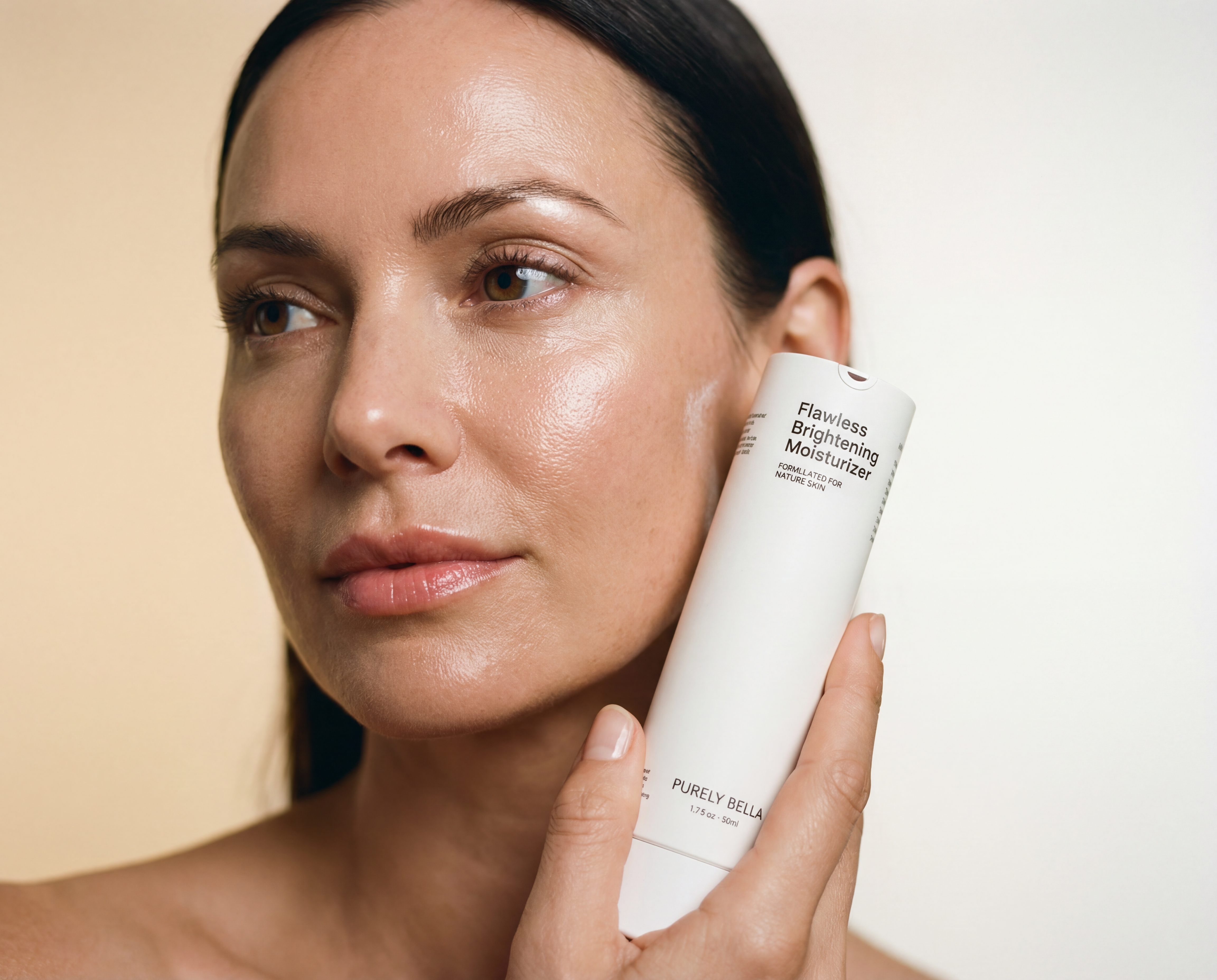
2. Reduce cellular inflammation. Use an antioxidant-rich formula morning and evening to neutralize the oxidative and inflammatory signals driving pigment production. PURELY BELLA's Flawless Brightening Moisturizer was formulated specifically for this — powered by astaxanthin to protect, calm, and gradually fade discoloration without the sensitivity that many brightening products cause on perimenopausal skin.
3. Manage heat triggers. Especially for melasma and PIH, temperature spikes worsen pigmentation. Keep PURELY BELLA's Serenity Cooling Mist with you to calm and reset skin throughout the day.
4. Be consistent — and patient. Hyperpigmentation in perimenopausal skin did not appear overnight, and it will not resolve overnight. Eight to twelve weeks of consistent treatment is the minimum timeline for visible improvement. Twelve to sixteen weeks for deeper pigmentation. The goal is steady, sustainable progress, not a dramatic fix that inflames skin in the process.
One More Thing I Want You to Hear
The dark spots you're noticing are not a failure of your skincare routine. They are not a reflection of how well you've "taken care of yourself." They are the natural, documented, biological result of hormonal changes your skin is navigating in real time.
You deserve a routine that understands that. Products formulated with those changes in mind, not products designed for a different skin, at a different life stage, with a different set of needs.
That's why PURELY BELLA exists.
Try the full collection with our 90-Day Glow Guarantee. No risk. No rush. Just your skin, supported.
Cathi Carrier is a licensed esthetician, certified health coach, and founder of PURELY BELLA. With over 32 years of experience, she creates clean, cruelty-free skincare formulated specifically for women navigating perimenopause and beyond.